
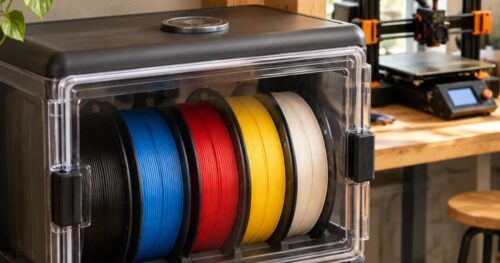
If your filament pops, hisses or leaves a stringy mess, it’s probably wet. Most filament soaks up moisture from the air, and wet filament prints worse and breaks more easily. Winter doesn’t make the problem go away. Carrying a cold spool into a warm room, or printing in a damp garage or workshop, can bring it on fast.
Signs your filament is wet
- Popping and crackling from the nozzle as water turns to steam
- Stringing and oozing between parts
- Rough, bubbly or fuzzy surfaces on a print that should be smooth
- Weak parts that snap more easily than they should
- Filament that snaps when you bend it, especially nylon
Any one of these can have other causes, like temperature or retraction settings. But if several show up together, check the filament first.
Drying it
A filament dryer is the easiest tool. A food dehydrator works too, as long as you only ever use it for filament and never for food. The drying temperature depends on the material. As a rough guide:
- PLA: around 45 to 55 °C for several hours
- PETG: around 60 to 65 °C for several hours
- TPU: around 50 to 55 °C
- Nylon: around 70 to 80 °C for longer, and it needs it most
Different brands have different limits, and a spool that gets too hot will warp. Check the temperature printed on your spool or on the maker’s page before you start.
Storing it
Drying fixes the problem, and storage keeps it from coming back:
- Keep spools in an airtight bin or bag with desiccant
- Add a small humidity indicator so you can see when the desiccant is used up
- Let cold spools come up to room temperature before you open the bag
- Close the container as soon as a print is done
If you print with materials like nylon, a dry box that feeds right into the printer keeps the filament dry while it prints.
A little time spent drying and sealing your spools saves you failed prints and wasted filament.